
Clayton County Traffic Court Records
Figuring out which court issued the ticket is step one. A citation written under county or state authority usually lands in Clayton State Court, where State Clerk Tiki Brown keeps the traffic records. A ticket written inside an incorporated city can stay with that city's Municipal Court instead. That split is why a valid citation sometimes fails to show up in a county docket search. For the county route, use the State Clerk's official traffic page; each city court runs its own citation calendar and payment rules.
The county Case Inquiry shows a Case Summary, party details, and Docket Activity. A traffic entry might hold a calendar action, a traffic-citation image, an outcome, a disposition, or a notice code. Keep its limits in mind. The Clayton County Court Search offers a public summary only, not a full driver history or a certified copy. City records sit on separate JusticeONE or CourtWare routes, so know the issuing court's name before you search or pay anything.
For county citations, the Clayton County Traffic Citation Inquiry page is the official inquiry route. The page presents no search fields on its face, so treat it as a starting point rather than a guaranteed working lookup form.
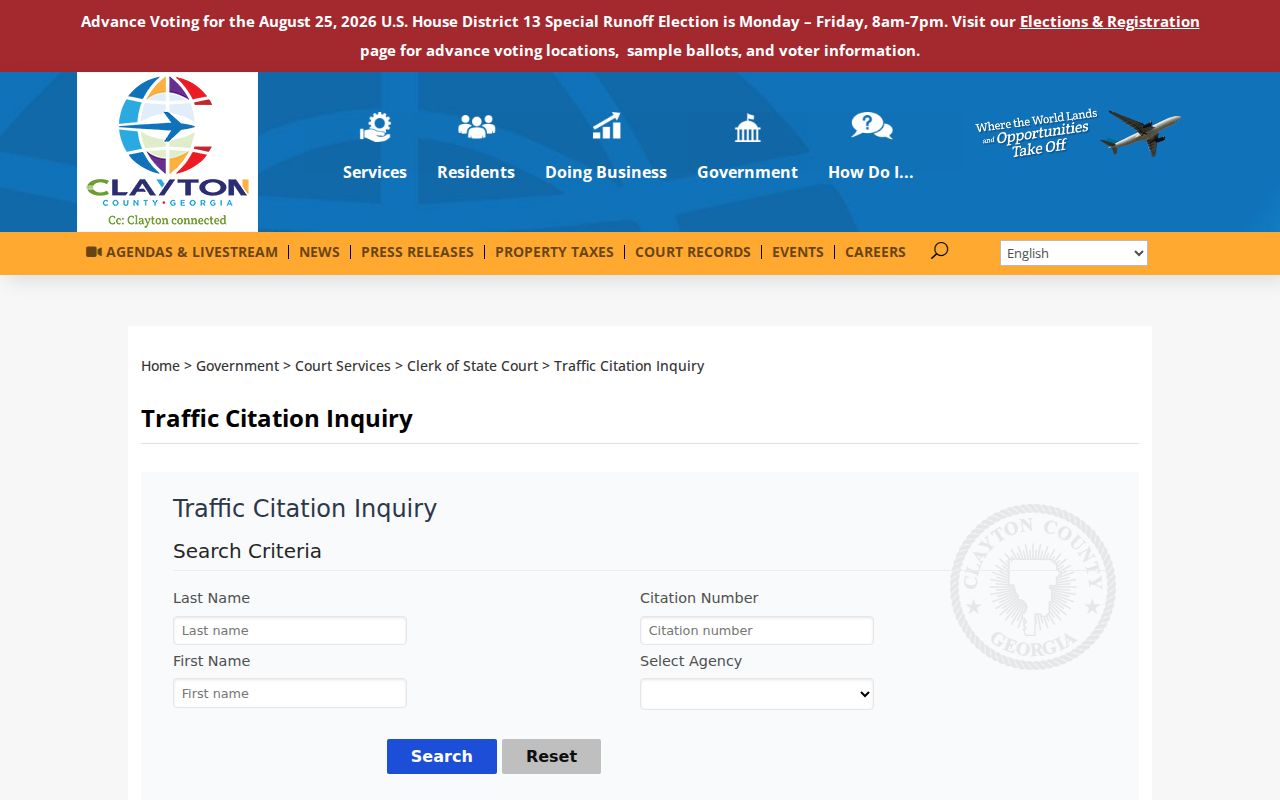
A blank page proves nothing. Empty fields on the inquiry page do not mean the traffic case does not exist. If the shell gives you no usable search, fall back on the State Clerk, the county Case Inquiry, or the issuing city court for a Clayton County court docket check.
Clayton County State Court or City Court?
Read the citation first. The court named on it tells you where to go. Clayton State Court covers county-wide misdemeanor and traffic matters, and its Traffic division is the usual destination for citations issued under county or state jurisdiction. To reach the office, the State Clerk lists the main line at (678) 479-5521 and the traffic line at (770) 477-3386. A general civil and criminal line, (770) 477-3388, is also published. A city ticket is different, even when the road or the charge looks identical to a State Court case, so use the municipal clerk or court administrator that city names.
| Starting point | What it covers | Next contact |
|---|---|---|
| Clayton State Court | County and state traffic citations held in the county traffic division. | State Clerk (678) 479-5521 or traffic (770) 477-3386. |
| City Municipal Court | Traffic and ordinance citations issued within an incorporated city. | The city court, its portal, or its published administrator. |
| County Case Inquiry | Public county criminal or traffic summary when the case is in a searchable county court. | Search by court, name, or case-number segments. |
Traffic payment hours differ from the broader office schedule, and the State Clerk page spells out both. Call before you travel. If a phone number, division, or payment instruction changes, the county's State Court page and the clerk page control.
The official State Clerk contact and division page shows the county records route. Note what it is not: a DDS driver-record search.
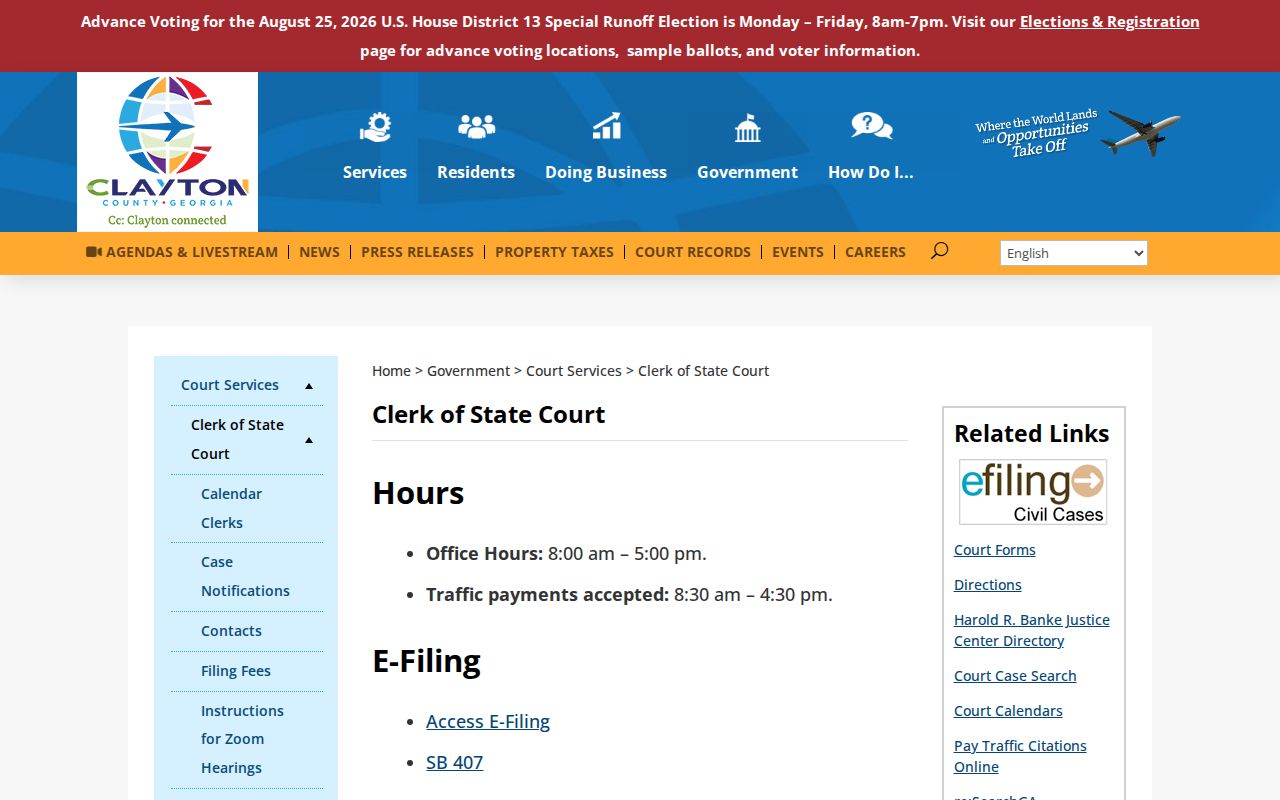
A city ticket stays a city matter, even when the county Case Inquiry is the easier tool. A municipal court record can carry its own case number, payment deadline, appearance rule, and fee. Follow the city route to the end.
Looking Up a Traffic Ticket
A Clayton County traffic ticket lookup runs through more than one channel. The citation number helps most, but once a State Court traffic case is in the system, the county search also works by name or by a segmented case number. A city citation may instead live on a CourtWare calendar, a JusticeONE payment route, or a city clerk's records counter. Keep inquiry and payment straight. A card-payment page can confirm what you owe while showing none of the docket history behind it.
- Read the citation and identify the issuing court. Keep the citation number, name, and stated court date together.
- Open the official county traffic inquiry page. If the shell does not expose fields, do not infer that the ticket is absent.
- For a county State Court matter, use the civil or criminal County Case Inquiry by selecting the court and searching by last name, first name, or the year, type, sequence, and division segments of a known number.
- For a city citation, use the city's own route. Forest Park and Morrow publish JusticeONE payment access; Riverdale, Lovejoy, and Jonesboro publish CourtWare or city-linked calendar and payment routes.
- Use the State Clerk traffic line, the city court phone, the relevant counter, or a courthouse public terminal when the ticket has not posted or the online route fails. A written or mailed records request goes to the issuing clerk, not to a different court.
- Write down the court, setting, amount, and response instruction before deciding whether to pay or contest. Confirm a disputed or changed date with the issuing court.
The public county search does not replace a clerk's confirmation. It can be limited by court, timing, exclusion, or a city filing. Use the search to find a likely record, then lean on the clerk's phone, counter, or mail procedure for a missing citation or a copy of the court docket.
Clayton County Traffic Citation Inquiry versus Payment
Inquiry and payment are different animals. An inquiry tells you whether a citation or case is visible and what the public docket reports; payment is a transaction through an approved channel. Per the State Clerk page, most eligible citations can be paid through the linked E-Fines route or by automated phone at 1-888-912-1527. That phone line takes payments only. The county traffic inquiry page and the County Case Inquiry stay separate from the payment step entirely.
Online payment accepts the card types the State Clerk lists, plus a third-party convenience fee per transaction. The county page posts no fixed percentage for that E-Fines fee. Processing takes 24 to 48 hours, and the court credits the date received, not the date the card was used. Paying a day or two before court can create a real timing problem. And if an appearance is required, attempting payment does not get you out of it.
The official State Clerk traffic-payment instructions lay out the payment route and the processing warning in full.
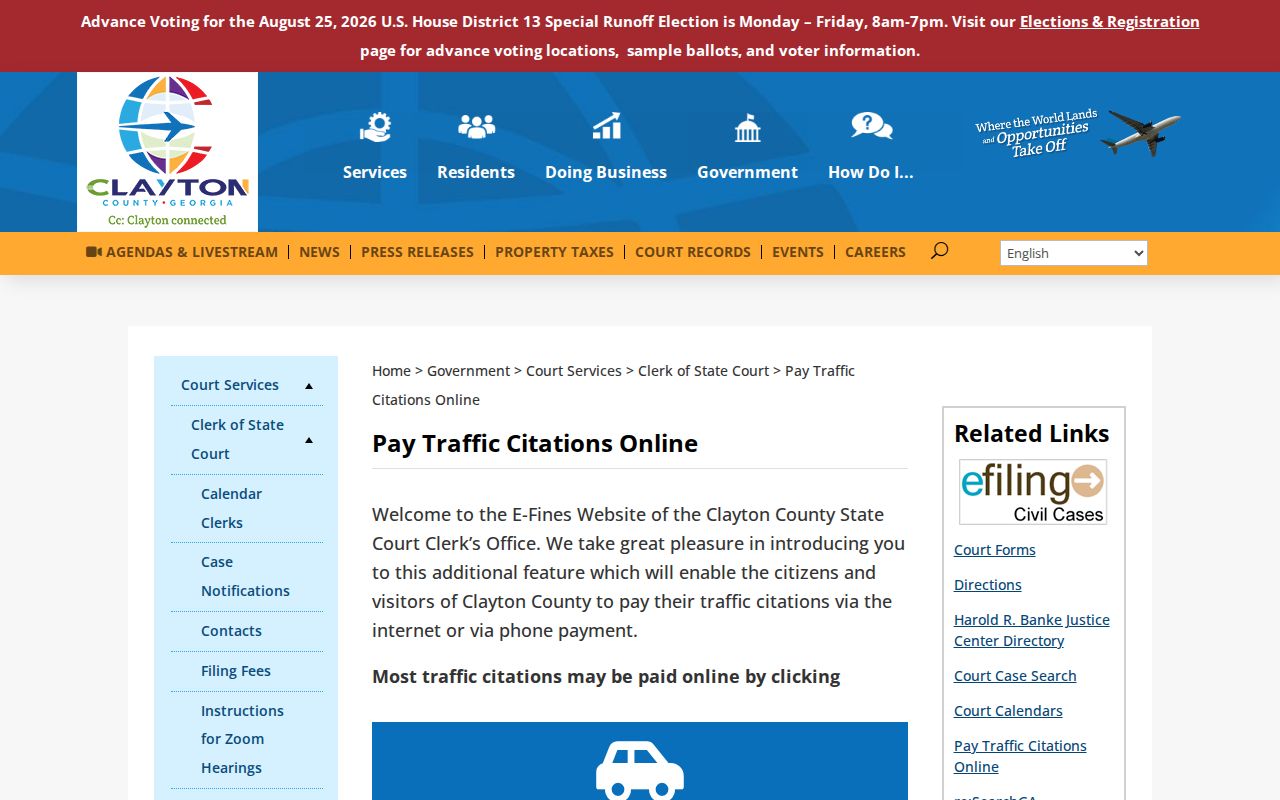
Those instructions show how to pay, not a live citation result. Keep the receipt, and when your court date is close, ask the issuing court to confirm it arrived.
How to Find Your Traffic Court Date
Two calendar layers cover a Clayton County traffic date. Start with the county Case Inquiry detail. Look at its newest Calendar action there. Then run the separate Court Calendar Search, which lets you query by case, name, date, or judge. Each result can list the date, time, judge, and calendar type. A row tagged TRAFFIC ARRAIGNMENT or "Traffic Arraignment Calendar" is only one setting in the case, not the whole history.
| Citation or case number | Use the citation number on the ticket. An observed county traffic case pattern is 2025 TK 12129; preserve every segment if the county assigns a case number. |
|---|---|
| Court and division | Select State Court/Criminal for a searchable county traffic matter, or use the named city Municipal Court route. |
| Date and time | Read the date and time in the calendar result and compare them with the newest Calendar action in the case detail. |
| Judge and calendar type | Record the judge and type, including a Traffic Arraignment label when shown. |
| Room and status | Follow the linked calendar detail or clerk confirmation for room and current status. A token or Turnstile check may protect the detail view. |
The county warns that some calendars are not eligible for posting online. A blank result proves nothing. Compare the older rows with the new ones, watch for a reset or an event outcome, and call the calendar clerk or the issuing court whenever the result clashes with what your citation says.
Clayton County Traffic Clerk Contacts
State Court traffic questions go to the State Clerk's office in Room 1CL181 at the Harold R. Banke Justice Center, 9151 Tara Boulevard, Jonesboro, Georgia 30236-4912. The main State Clerk number is (678) 479-5521. The published traffic line is (770) 477-3386. Payments at the State Court traffic window are accepted 8:30 a.m. to 4:30 p.m., though general clerk hours and the payment cutoff are two different things.
For a county or state-jurisdiction citation, use those contacts. A city ticket belongs to that city's administrator or municipal clerk instead. Calendar questions sometimes go to the assigned judge group, not the payment window. When you call for a date, payment status, or a copy, keep the citation, the county case number, the court division, and the newest setting in hand.
Clayton County Traffic Arraignment Rows
An arraignment row is part of the court's setting record. It can tell you when the matter gets called and which calendar group handles it. On the docket, that Calendar action may sit next to a Traffic Citation image-document entry. It may also sit near an Event Outcome, a Final Case Disp, or later administrative activity. Read the action date and its description as a pair. The header status alone will not settle it. It will not say whether the citation was paid, contested, reset, dismissed, or resolved at a later hearing.
| Docket label | Plain meaning | Do not assume |
|---|---|---|
| Traffic Arraignment Calendar | A traffic matter is grouped for an arraignment or related appearance. | That the setting is the only or final event. |
| Calendar | A case event may link to date, time, room, or calendar type. | That an old calendar row is still active. |
| Traffic Citation | An image-document entry may point to a scanned citation. | That the image is a certified copy or a DDS record. |
| Final Case Disp | A final-disposition activity is recorded. | That the action history can be skipped. |
When a date controls an appearance, treat the newest un-cancelled setting as a lead only. Verify it with the court. A city CourtWare row uses different labels than the county CGI system. So do not expect a perfect match. The portal is good evidence of a setting. The issuing clerk is still the confirmation route.
Pay or Contest a Ticket
Paying and contesting are separate roads. If the citation is payable, use the official county or city channel, leave time for processing, and hold onto the receipt. Some citations require an appearance instead. Others get contested. In those cases, contact the issuing court and follow its plea and setting instructions rather than treating payment as a shortcut. Reconcile the date printed on the citation, any later court notice, and the newest calendar entry with the clerk.
| Paying the ticket | Contesting the ticket |
|---|---|
| Use E-Fines, the automated phone route, or the city payment channel only when the citation is eligible. | Contact the issuing court for the plea, appearance, and trial instructions that apply to the citation. |
| Allow 7 to 10 business days for a new ticket to process and 24 to 48 hours for a payment to reach the court. | Do not wait for an online payment screen to decide a contested matter. Confirm the response deadline with the court. |
| Save the receipt and ask the court to confirm receipt when the date is near. | Attend the setting or follow the court's written instruction. A required appearance is not replaced by a payment attempt. |
Missed date or late payment: A failure to appear or a payment that reaches the court late can lead to a warrant, a license hold or suspension, or other court action under the issuing court's rules. Call the State Clerk at (678) 479-5521 or (770) 477-3386 for a State Court ticket, or call the city court named on a municipal citation immediately.
Clayton County Traffic Processing Time
The State Clerk gives a practical window for postings. A citation has to be received and processed first. Allow 7 to 10 business days. That is how long to wait before expecting the county payment route or the court record to appear. That estimate is not permission to ignore the date printed on the ticket. Keep the original citation. If the date arrives before the ticket shows up online, check with the issuing court.
After you pay, the transaction may need 24 to 48 hours to reach the court. The court counts the date it receives the payment. It does not count the date you typed in your card details. A convenience fee comes with the third-party payment route. The county page gives no fixed E-Fines percentage. City tickets follow the city's own posted fee and deadline instead.
| Event | Timing note |
|---|---|
| New citation reaches the court | Allow 7 to 10 business days for processing before expecting an online payment or county record to be ready. |
| Online or phone payment reaches court | Allow 24 to 48 hours; the posted date is the date received. |
| Ticket does not appear | Use the clerk phone, counter, public terminal, or issuing city office. Do not pay a different court by mistake. |
The State Clerk's official payment page carries the timing warning. If your date is close, confirm it with the court directly instead of trusting a delayed status.
Traffic Court Record vs Driving Record
A Clayton County traffic court record and a Georgia Department of Driver Services record are different files. They have different jobs. The court file tracks the citation, the plea or appearance, docket activity, disposition, any fine, and court notices. DDS keeps the driving-history and licensing side. A court lookup that comes back blank, delayed, or limited says nothing about what sits on a driver's state record. A DDS record, in turn, never substitutes for a certified court disposition.
| Court traffic record | Driver record | |
|---|---|---|
| Kept by | State Court clerk or the city Municipal Court that issued the citation. | Georgia Department of Driver Services. |
| Shows | Citation, parties, setting, docket activity, plea or disposition, fine, and possible notice activity. | Driving-history and licensing information maintained by DDS. |
| Access route | County Case Inquiry, city CourtWare or JusticeONE route, clerk counter, phone, mail, or records request. | DDS driver-record process, separate from the court docket. |
The difference matters when you see DPS912. That code is a court-docket notice label. It is not a driver-record field. Anyone needing a court copy should ask the issuing clerk for the court file or a certified disposition.
Clayton County Traffic DPS912 Notice Code
Spotting DPS912 on a Clayton County traffic docket tells you one specific thing. The clerk sent a notice to the Georgia Department of Driver Services. The reason was a driver's failure to appear. That is all it means. The code is not the citation itself. It is not a guilty finding, not a payment receipt, and not a full DDS driving record. The action date plus the Docket Activity around it carry the real story. The issuing court decides how a missed appearance gets cleared.
Once you see the code, call the State Clerk's traffic line. Or call the city court printed on the citation. Ask which court holds the file. Ask whether a new court date or payment instruction exists. Ask what proof the court wants from you. The county's abbreviation definitions decode the label. But only a clerk can speak to your specific case.
Keep two records straight when you ask. The court docket entry belongs to the court, while DDS controls the licensing record. Do not assume one from the other.
Copies and Fees
A convenience fee for paying online is not the fee for a copy of a court record. First figure out which office holds the traffic file you want. State Court traffic cases sit with the State Clerk. A city citation belongs to that city's Municipal Court. Then ask exactly what you are requesting. A plain copy, a certified disposition, a citation image, and a full file can carry different prices. Each issuing court sets its own schedule. Clayton County has no single fixed traffic-copy amount.
| Item | Fee or route | What to confirm |
|---|---|---|
| County E-Fines convenience fee | Third-party fee per transaction | The official county payment page does not state a fixed percentage. |
| Plain traffic-file copy | Ask the issuing clerk for the current amount | Whether the request is per page, image, or file. |
| Certified disposition | Ask State Court or the municipal clerk | Certification charge, delivery method, and required case or citation number. |
| Written public-record request | Use the responsible records custodian | Whether the item is a court record, an administrative record, or restricted. |
Some records requests fall outside the court file entirely. For those, Clayton County runs an administrative public-records channel. The official Clayton Open Records portal shows that route and how to submit a request through it. Remember, though, it is not a loophole. Juvenile confidentiality, sealed files, and protected identifiers still apply no matter which channel you use.
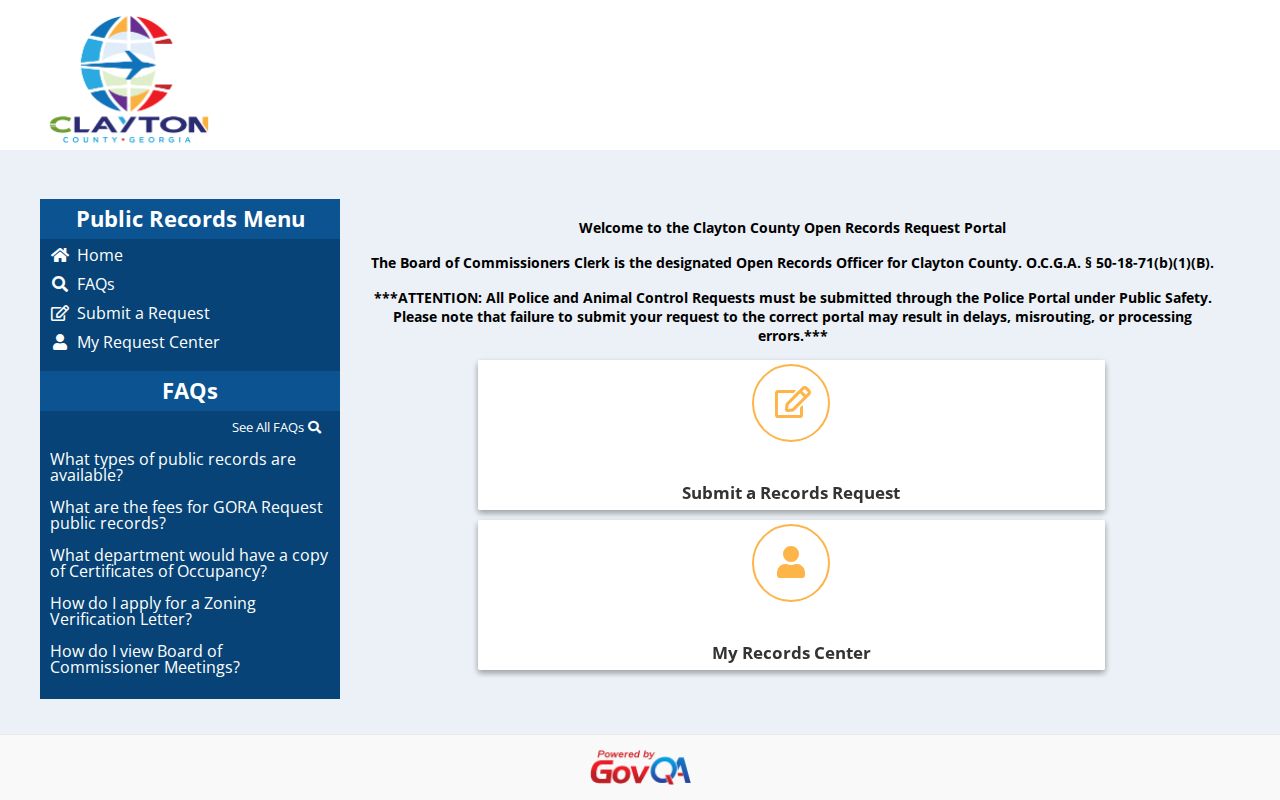
That portal is an administrative tool and nothing more. A copy of a traffic docket still comes from the State Clerk or the city court that keeps the case file.
Clayton County Traffic Failure to Appear
A failure to appear changes everything about your next move. Stop retrying the payment page. A blank docket inquiry does not clear the matter either. Contact the issuing State or Municipal Court right away with your citation or case number, and ask about the current setting, whether you can still pay, and how to resolve the missed appearance. Clayton County's traffic material warns that late processing can trigger added penalties or license suspension, while city materials point to FTA consequences like a warrant or a license hold.
Match the channel to the file. For State Court traffic, call (678) 479-5521 or (770) 477-3386, and check the county calendar route for a posted hearing date. A city ticket means the city administrator, that court's phone, the city calendar, or its payment route. Need the record itself? Ask the clerk or records counter about a plain or certified copy and follow the court's mail or in-person process.
Verification rule: A public traffic row, a payment receipt, a DPS912 notice, and a DDS driver record are separate pieces of information. Match the court, case or citation number, and latest setting before relying on any one of them.
Questions about public access to Clayton County court records turn on Georgia law. The official Open Records Act guide and the clerk's own procedures control. A public docket never opens restricted or protected information to the world.