
Searching Clayton County Civil Dockets
Clayton County's civil name search lets you pick All Courts, State Court, Magistrate Court, or Superior Court. Choose the court first. Then enter the required last name. The case-number route works differently. It has a narrower court selector and segmented fields. Know the case type already? Start from the court. If not, run the name form on All Courts. Then confirm the court, case type, filing date, opposing party, and judge from the results.
The civil result table lists Type, Name, Opposing Party, Case Type, Filing Date, Case Number / Status, Court, and Judge. Clicking through opens a detail view. It separates basic information, parties and attorneys, and Docket Activity. An Image Document or Calendar row can point to a useful next step. Just remember one thing. A free display is not automatically a certified copy or the complete court file.
- Open the civil name or case-number route and select the court that fits the matter.
- Enter the required last name, adding the optional first name or initial when a common name produces many results.
- For a known number, enter Year, Type, Sequence, and optional Division exactly as the court shows them.
- Compare the result’s opposing party, case type, filing date, court, judge, and status before opening the case.
- Read Docket Activity and ask the correct clerk for the filed pleading, order, judgment, or certified copy if needed.
Clayton County Civil Search Fields
The civil name form shares its core controls with the criminal form. Its results are built around civil parties and opposing parties. Last name is required and takes up to 70 characters. First name is optional, capped at 20. All Courts appears on the name route only. The case-number route makes you choose State, Magistrate, or Superior Court instead.
| Field | Required | Clayton civil form detail |
|---|---|---|
| Select Court | Yes | All Courts, State Court, Magistrate Court, or Superior Court on the name route |
| Last Name | Yes | Text field, maximum 70 characters, placeholder “last” |
| First Name | No | Maximum 20 characters, usable as an initial or full name |
| Year | Yes for number search | Four-digit year, with 2004 shown as a form example |
| Type | Yes for number search | Two-character type, with CV shown in the form example |
| Sequence and Division | Sequence required; Division optional | Up to five numeric sequence characters and an optional two-character division |
A "Please Select a Court" message means the court selector was skipped. Check that before retyping the name. An "Incomplete Case Number" message calls for comparing each segment against the notice or court document. The reset button clears the form. That is handy when moving between an All Courts name search and a single-court number search.
The official civil form lays out the court choices. It also shows the party-name fields a Clayton County civil docket search depends on. The Clayton civil name-search form is the source for those visible controls.
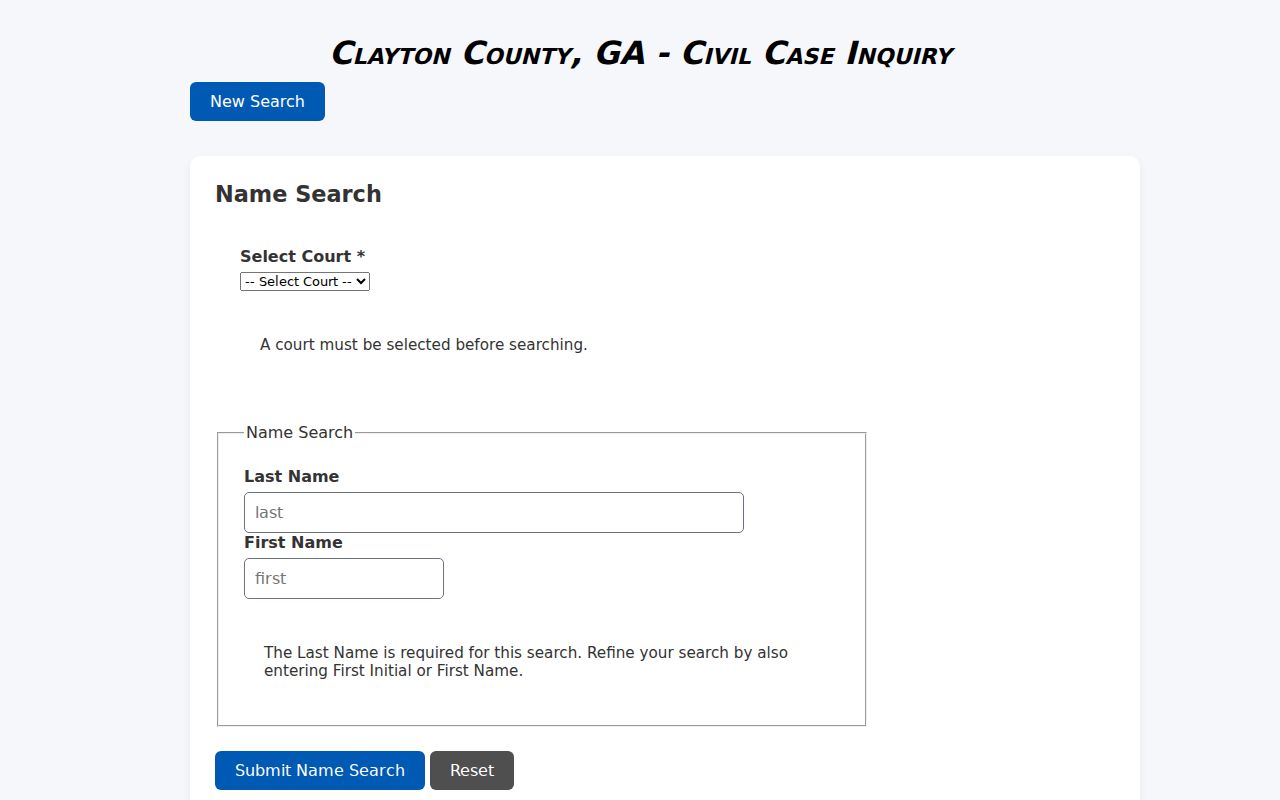
The form’s court selector helps keep a civil result tied to the correct clerk.
Inside a Clayton County Civil Docket
Open a civil detail page in Clayton County. The Case Summary and Basic Case Information come first. That block holds the case number, the assigned judge, the filing date, and the case status. It also carries a disposition date plus the disposition itself. Next comes Case Parties. That section names each side, the party types, and any attorneys of record.
Docket Activity is the running log. Every row pairs an action date with a docket action and a short description. Common entries there include Case Filing, Service, Answer, Calendar, Image Document, Event Outcome, and Final Case Disp.
| Case number | Year, type, sequence, and optional division, such as 2025 CM 01399 in the inspected sample route. |
|---|---|
| Case type | Interface labels such as Civil Suit, Account, Note, or Patho/Dispossessory, depending on the record. |
| Parties and attorneys | Party name, party type, opposing party, and attorney fields shown by the public detail. |
| Filing and service | Docket actions that mark a complaint, answer, service event, or related filing. |
| Calendar | A setting row that may connect to date, time, room, judge, and calendar type. |
| Disposition | Status, disposition date, and final action labels that need the activity history for context. |
Think of a civil docket as a timeline rather than a full file cabinet. A Calendar row won't replay every motion raised at a hearing. An Image Document may be a public scan. Yet it is not automatically certified. For a judgment, a pleading, a service return, a divorce decree, or anything else actually filed, go through the clerk's copy and certification route. The county's civil sample shows the public field groups. It keeps any private party's identity out of the picture.
The county civil detail route is where the Case Summary and Docket Activity field families live.
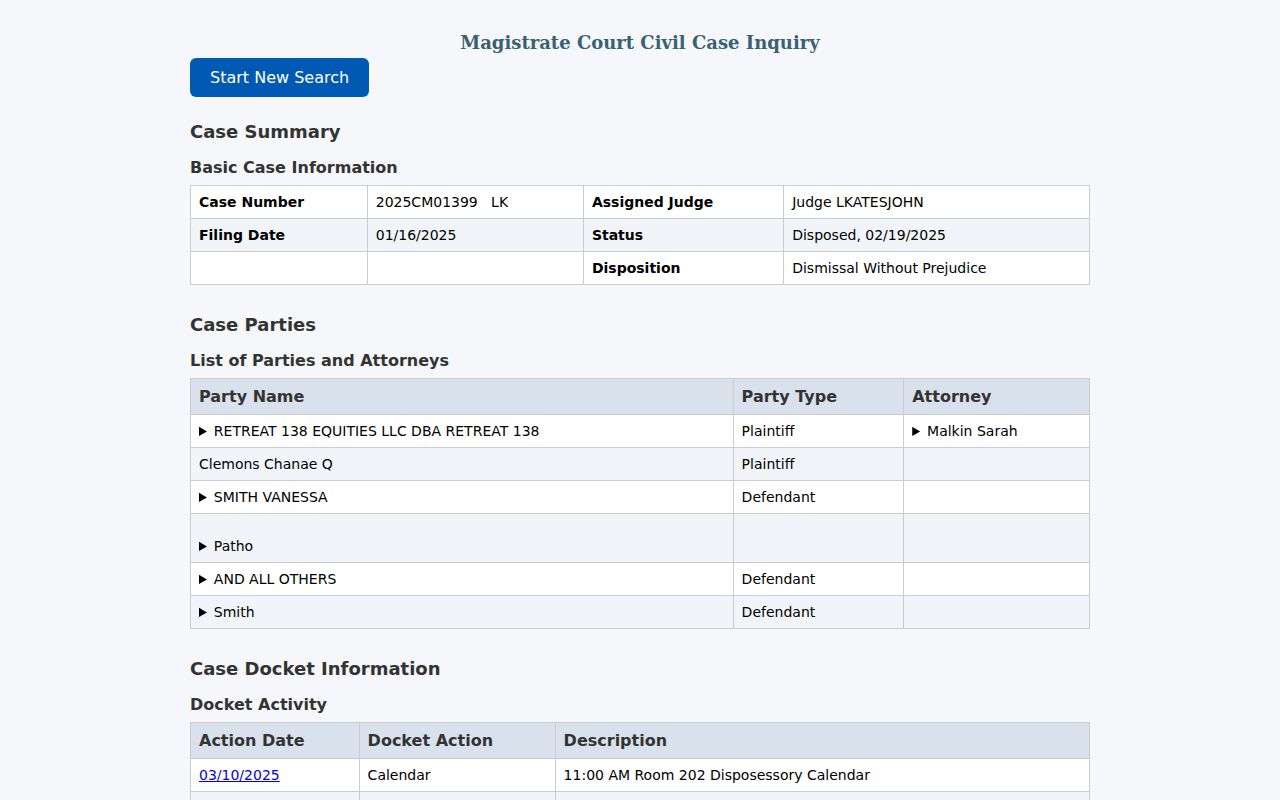
Read the header and the activity table together. That habit keeps a status label from standing in for the whole case history.
Clayton County Civil Case Coding
A Clayton County civil number has four parts. Those are the year, a two-character type, a sequence, and an optional division. County examples include 2004 CV 03272 LW and 2005 CS 00052 07. The result table then adds a plain-language case type and a court label. That helps you tell the number's format apart from the nature of the filing. Watch out for look-alikes. A city vendor number or a deed-book reference is not automatically a county civil case number.
Labels you might see in the civil interface include Patho or Dispossessory, Civil Suit, Account, and Note. They describe the county's result vocabulary, nothing more. No label is a conclusion about any specific party. Read it alongside the court, the filing date, and the opposing-party field.
- Case Summary
- The basic information block at the top of the public civil detail.
- Docket Activity
- The dated list of civil filings, service, settings, documents, and outcomes.
- Calendar
- A docket or calendar row connected to a hearing setting.
- Image Document
- A row that may open a scanned document, without promising certification.
- Final Case Disp
- A final-disposition activity label that should be read with the underlying record.
A case number search can dead-end, so switch to the name form at the same court. Name matches can pile up. When they do, compare the full case number instead of trusting a short type label to tell records apart.
Civil Case Types on the Docket
Civil dockets in Clayton County split by jurisdiction. Superior Court takes the big lane. It covers civil actions across its broad reach, plus exclusive matters like title to land, divorce, equity, and certain extraordinary relief. State Court hears civil actions too, whenever Superior Court does not hold exclusive jurisdiction. Magistrate Court generally covers civil disputes of $15,000 or less. Dispossessory and PATHO-related matters sit there as well. Municipal courts stick to local ordinance and ticket cases, not ordinary county civil filings.
| Court | Civil role | Search and record route |
|---|---|---|
| Superior Court | Broad civil jurisdiction, domestic, title, equity, and exclusive categories | Superior selected in County Court Search; Superior Clerk |
| State Court | Non-exclusive civil actions outside Superior’s exclusive jurisdiction | State selected in County Court Search; State Civil clerk |
| Magistrate Court | Generally $15,000 or less, dispossessory, PATHO, and related civil process | Magistrate route and combined clerk |
| Municipal Court | City ordinances, citations, and local code matters | Issuing city court or city vendor system |
The dollar cutoff is a routing clue, nothing more. It cannot override the court's full jurisdiction rules. A modest civil result may still sit in Superior or State Court because the subject falls under an exclusive or different category. Search the court named on the case paper first. If the result does not fit, verify with the clerk.
Clayton County Magistrate Civil Boundary
Don't mistake Magistrate Court for a small State Court. In Clayton County it handles civil claims of roughly $15,000 or less, plus dispossessory and PATHO matters, warrants, preliminary matters, and county-ordinance work. Its clerk runs a separate civil e-filing and service path. A civil action, PATHO, or dispossessory without service runs $50 under the 2023 fee schedule. Process-server civil service costs $65 per party. Confirm those amounts before paying. The schedule carries a date.
New Magistrate civil entries can take up to 72 hours to show online, the clerk's material warns. Behind that delay sits real workload. The county's Magistrate backlog project describes it. Abandoned motor vehicle and dispossessory filings each have their own routing instructions too. A blank State or Superior docket search proves nothing here. The functions and fees are distinct. Because of that, a Clayton County Magistrate case can exist without appearing in those courts.
The court's own page lays out this separate civil route. The official Magistrate Court information covers the court's civil and related functions.
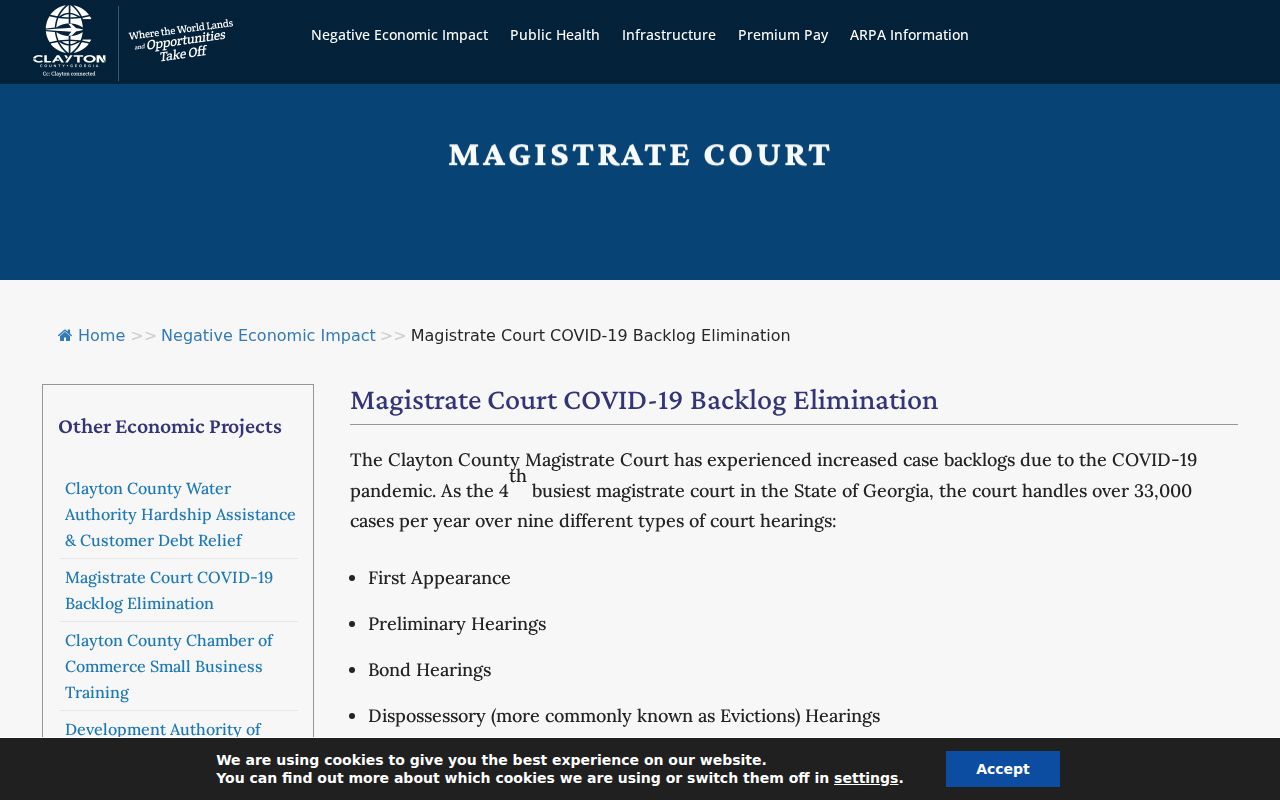
Reading a Magistrate result: Match it against the court's own filing, service, and copy instructions before drawing conclusions.
Civil Docket Settings and Hearings
Civil Docket Activity rows come in several flavors. Types include Calendar, Motion, Service, Answer, Event Outcome, and Final Case Disp. A Calendar entry can give date, time, room, judge, and calendar type. The county's standalone calendar is a different search, though. When a setting truly matters, compare the newest calendar action with the Court Calendar result. A new row, a reset, or an outcome can shift the practical date.
For a motion, pull the case, the assigned judge, the filing date, and the linked docket action. A setting is a request, not a ruling. An Image Document link may hold the order or pleading. Certified copies come from the clerk. If an online detail runs thin, call the right civil division. Or visit the counter during its posted hours.
One quirk: county calendar details may demand an interactive verification token. Some calendars never qualify for Internet posting. So treat a blank calendar result as a prompt. Check the docket and the clerk. It is not a final answer.
Clayton County Filing and Service Rules
Clayton's civil and criminal e-filing now runs through Odyssey eFileGA. It took over February 1, 2024, after PeachCourt. Know what it is: a filing engine, not the free public Case Inquiry. A receipt can arrive before anything shows on the public docket. Superior motions carry an extra duty under Rule 6.1. They need contemporaneous email notice to opposing parties and the assigned judge or designee, within 24 hours of e-filing. That rule shapes practice around a filing. It does not open every underlying document to the public.
| Rule or event | What it changes | Practical search point |
|---|---|---|
| Odyssey eFileGA | Mandatory electronic filing route for covered Clayton civil and criminal filings | Search the county inquiry for public visibility after filing |
| Superior Rule 6.1 | Contemporaneous email notice for covered motions | Look for the filing and later calendar or outcome row |
| Magistrate civil route | Separate e-filing and service process | Use Magistrate clerk instructions and allow publication time |
| Service | Sheriff-service and process-server directions depend on court and filing type | Confirm the correct office before sending a fee or request |
For Magistrate civil service, the county now points filers to direct filing. The Sheriff's Department handles this on the stated routes. Service, filing, and copy rules differ court by court. A civil docket search alone cannot tell you service was completed just because a case row exists.
The State Court filing-fee source gives a current-dated example of civil filing and service charges, keeping State civil fees distinct from the Superior and Magistrate schedules.
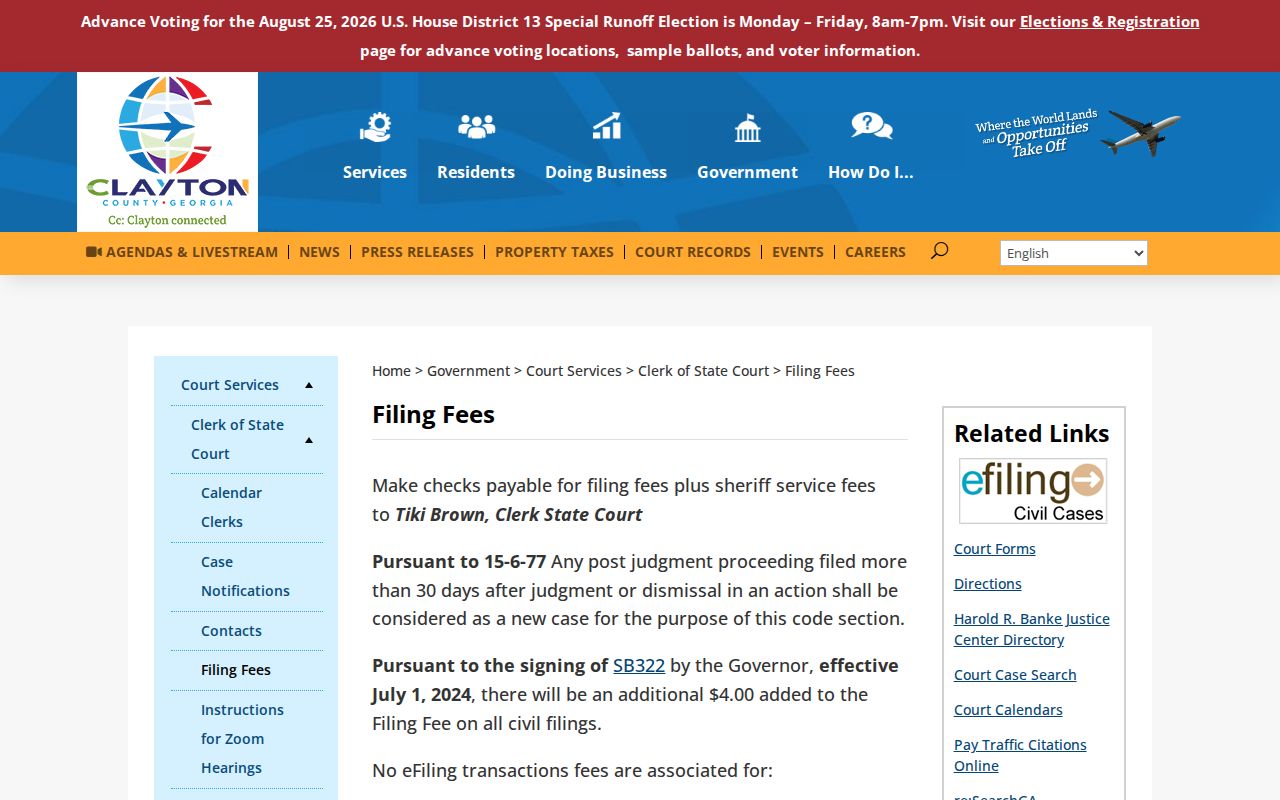
Checking a filing question: Read any fee's vintage and the court choice alongside the docket record itself.
Civil Docket Access Rules
Most civil dockets are public. Not everything in them is. Sealed filings, protected identifiers, adoption material, protective orders, and similar restricted documents can be withheld or redacted. Uniform Superior Court Rule 21 sets the public-access starting point, and Rules 21.1 through 21.6 spell out restriction and protected-identifier procedures. The Open Records Act is related law. It does not replace the clerk's court-record process.
Access pointers:
Uniform Superior Court Rule 21 treats court records as public unless a lawful restriction applies.
O.C.G.A. 50-18-70 through 50-18-72 explain Georgia open-records inspection, copying, exemptions, and response timing.
Model Rule 36.16 preserves the public-access treatment of e-filed documents while leaving sealed or restricted filings outside the ordinary route.
Split the work. The county Case Inquiry gives the public summary, the clerk handles plain or certified filings, and the court answers sealing or restriction questions. A missing Image Document may mean a restriction or simply no scan. It never proves the docket event failed to occur.
Clayton County Civil Record Fallback
A civil search can come back empty. Retry the alternate form first. Confirm the court. The matter might sit in Probate, Juvenile, or municipal court, or be sealed, pre-JIS, or an older paper or microfilm record. Then contact the proper division. Superior Court Records occupies Room 1CL19 at the Justice Center, and the Superior/Magistrate clerk keeps the Real Estate route in Room 1CL25. State Civil belongs to Tiki Brown's office in Room 1CL181. Ask for a certified copy by naming the court, case number, document, and delivery need.
Superior Civil Records
Room 1CL19, Harold R. Banke Justice Center
(770) 477-3405
Superior civil, domestic, and related court records.
State Civil Clerk
Room 1CL181, Harold R. Banke Justice Center
(770) 477-3388 general; (770) 477-3390 supervisor
State civil records and filing questions.
Magistrate Civil Clerk
Use the combined Superior and Magistrate clerk route for civil claims, dispossessory, and PATHO records.
(770) 477-3443 clerk line
Three systems, three wrong doors. GovQA handles administrative open-records requests. It cannot bypass a court-file restriction. Real-estate deeds go through a different clerk and the GSCCCA route. Federal civil cases live on PACER. Keeping these straight helps. It keeps a civil docket search from wandering into the wrong record family.
With a known filing number in hand, try one more thing. The civil case-number search offers the official Year, Type, Sequence, and Division controls.
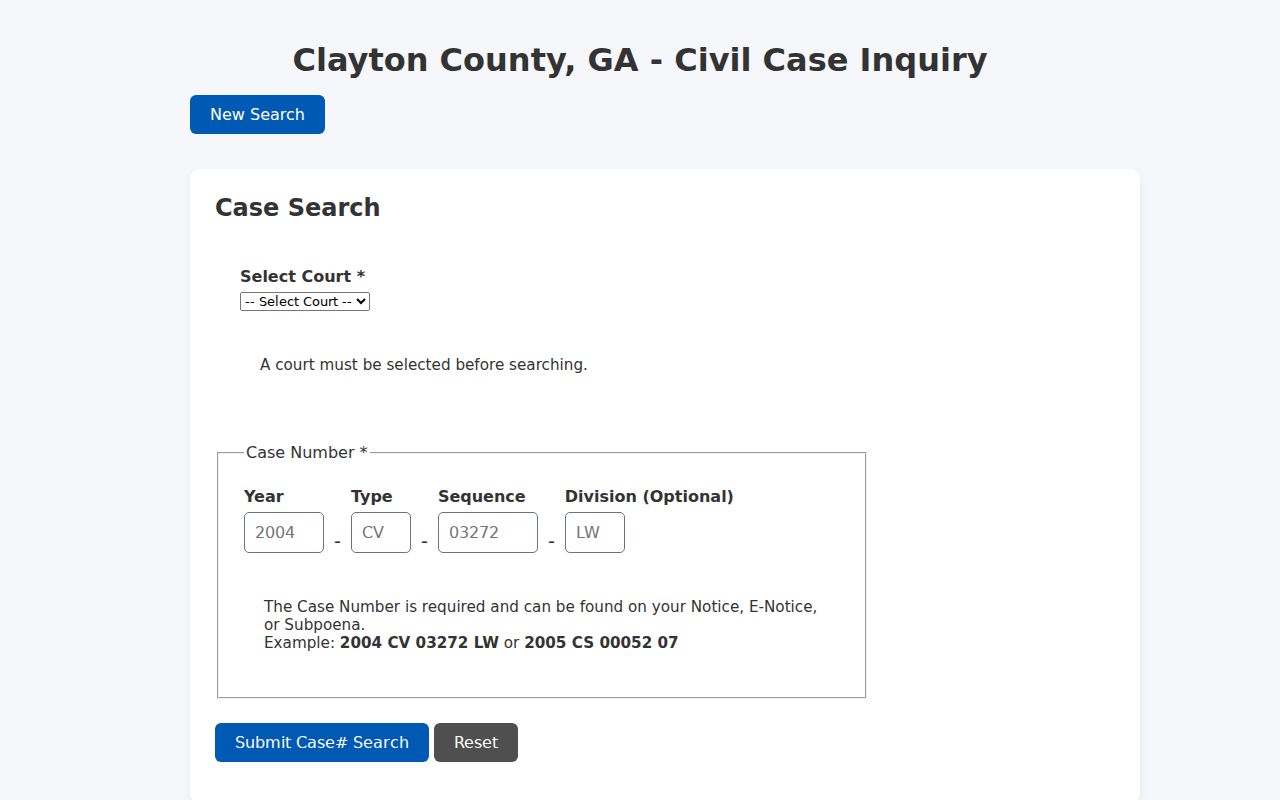
Using the right segments: Matching each part of a known number can spare you a second request to the clerk.