
Searching the Clayton County Court Docket
Start at Clayton County Court Search, the county's main public door to its court docket. Case Inquiry lets you search a civil or criminal docket by name. Or use a case number in segments. The database holds the public Superior, State, and Magistrate material the county has entered so far. It shows records. It does not accept filings. Clicking a result row opens Case Summary, Case Parties, and Docket Activity, though a certified copy, a linked image, or an older file may still take a trip to the clerk.
- Choose the civil or criminal inquiry that matches the matter, then select the court or All Courts where that option is offered.
- Enter a last name of no more than 70 characters. Add the optional first name, which accepts up to 20 characters, to narrow a common result.
- For a known number, use the four-part fields and preserve the year, type, sequence, and division exactly as shown on the court notice.
- Open the case number and read the status, parties, filing date, judge, Docket Activity, Calendar rows, and Image Document links together.
- Ask the correct clerk for a plain, certified, or exemplified copy when the online summary is not enough or an access limit applies.
Clayton County Case Inquiry
Prepare before you search the Clayton County court docket. Have the last name ready. Add a first name or initial, the court, and any case number from a notice. The name form allows All Courts, State Court, Magistrate Court, or Superior Court. The number form wants year, type, sequence, and an optional division. Watch that court choice. A city citation, a Probate file, a Juvenile matter, or a federal case may sit outside the ordinary county inquiry entirely.
| Search route | Field | Rule or option |
|---|---|---|
| Name | Select Court | All Courts, State Court, Magistrate Court, or Superior Court |
| Name | Last Name | Required text field, maximum 70 characters |
| Name | First Name | Optional, maximum 20 characters; first initial or full name may refine results |
| Case number | Year / Type / Sequence | Four-digit year, two-character type, and up to five numeric sequence characters |
| Case number | Division | Optional two-character segment, such as LW or 07 in the portal examples |
The county runs its Case Inquiry on old-style CGI pages, so labels can look plain even when results carry useful links. Hit Reset when you switch from a name search to a number search. Before opening later rows, jot down the court, case number, filing date, and status. That habit helps you tell a similar name apart from the case tied to your notice. For broader navigation around courts and clerk services, Clayton County’s official government homepage frames the court system in its county context. It is the wider government entry point. The searchable case fields themselves live in the Case Inquiry, not there.
That distinction matters. It keeps a general county information page from being mistaken for a case result or a document repository.
Inside a Clayton County Court Docket
The Clayton public detail view stacks three layers. Basic Case Information gives you the case number, assigned judge, filing date, status, and disposition date when one exists. Case Parties lists each party name, party type, and attorney. Docket Activity is the chronological register. It covers actions like a filing, service, answer, calendar event, image document, final disposition, or event outcome. Treat a displayed status as a summary only. The events beneath it explain how the case actually reached that status.
| Case number | The local year, case type, sequence, and optional division, shown in a format such as 2004 CV 03272 LW. |
|---|---|
| Parties | Names, party types, opposing party information in civil rows, and attorney fields when the public display includes them. |
| Docket Activity | Action date, docket action, and description, with some Calendar or Image Document links. |
| Hearing settings | Date, time, room, judge, and calendar type when a calendar row carries those fields. |
| Court and judge | The court selected or returned by the inquiry and the assigned judge shown in the result or detail. |
| Status and disposition | A current-looking label or final disposition field that must be read with the full action history. |
A case marked Disposed may still hold surprises. Look for a final order, a sentence, a service entry, an image, or a later administrative row. A Calendar entry can show a setting without reproducing every filing discussed there. Read the header, party table, and action table as one set. That gets the most from the public record. For court-level background, the county’s Superior Court page sits behind the felony and broad civil docket entries. The official Superior Court information covers jurisdiction and court access context.
The court holding the docket matters as much as the search phrase itself. Clayton County courts each keep their own rows.
Clayton County Docket Case Numbers
Clayton’s number search splits a case identifier into Year, Type, Sequence, and Division. The county’s own examples are 2004 CV 03272 LW and 2005 CS 00052 07. The year is a four-digit number. The type uses two characters. The sequence can use up to five numeric characters. An optional final division may use two characters. These segments help the portal find a row, but they do not make a city vendor number interchangeable with a county number.
Case number and status appear together in result tables. Civil rows also show opposing party and case type. Criminal rows show offense. Court abbreviations such as Mag, Sta, and Sup point to Magistrate, State, and Superior routing. Expand those labels before drawing a conclusion about the court or the kind of case.
- Case Inquiry
- The county’s public search and detail route for locating a case.
- Case Summary
- The detail heading that groups basic case information before the party and action sections.
- Docket Activity
- The dated register of filings, settings, service, outcomes, and other public actions.
- Final Case Disp
- A county label for final disposition activity, which should be read with its related action.
- Image Document
- A docket row that may lead to a scanned public document, not necessarily a certified copy.
- Event Outcome
- An outcome entry connected to a docket or hearing event.
A short code can describe a procedural event rather than the full ruling. Plain language matters. The official county abbreviation sheet is the proper source for criminal codes, and a clerk can explain the record route without giving legal advice.
Docket routing begins with the court’s function, not with a broad name search. The Magistrate Court page shows this directly. Clayton Magistrate Court’s official page identifies its civil, warrant, preliminary, and ordinance roles.
That court-specific context helps separate a small civil claim or preliminary matter from a Superior or State Court case. It keeps a Clayton County docket search pointed at the right bench.
Courts That Keep Dockets in Clayton County
Clayton County runs several courts out of one courthouse complex. No single docket holds them all. Each court keeps its own records. Superior Court takes the felony prosecutions plus the broad civil cases. State Court covers misdemeanors, traffic matters, and civil claims it shares with other courts.
Magistrate Court hears civil claims of $15,000 or less. It also handles dispossessory and PATHO matters, warrants, preliminary proceedings, and county-ordinance cases. Probate, Juvenile, and the city Municipal Courts each keep their own dockets. Access rules differ.
| Court | Docket covers | Where to search or ask |
|---|---|---|
| Superior Court | Felony criminal, broad civil, domestic, adoption, and lower-court appeals | County Court Search with Superior selected; Superior Clerk |
| State Court | Misdemeanor, traffic, and civil cases outside Superior’s exclusive jurisdiction | County Court Search with State selected; State Clerk |
| Magistrate Court | Claims generally $15,000 or less, dispossessory/PATHO, warrants, and preliminary matters | County inquiry where indexed; Magistrate or Superior/Magistrate Clerk |
| Probate Court | Wills, estates, guardianships, and probate applications | Georgia Probate Records and Probate counter |
| Juvenile and Municipal Courts | Restricted child matters, or city traffic and ordinance cases | Specialized court or city portal, not the ordinary county search |
Clayton County runs several separate courts. Each keeps its own docket records. A city traffic citation stays with a municipal court. A county or state traffic matter may land in State Court instead. Probate and Juvenile records sit outside the ordinary public name search on purpose. So step one is knowing which court holds your case. The official landing page handles that routing well, even when you begin with the wrong form.
The Clayton County courts landing page lays out the separate Superior, State, Magistrate, Probate, and Juvenile functions. They all appear on one official screen.
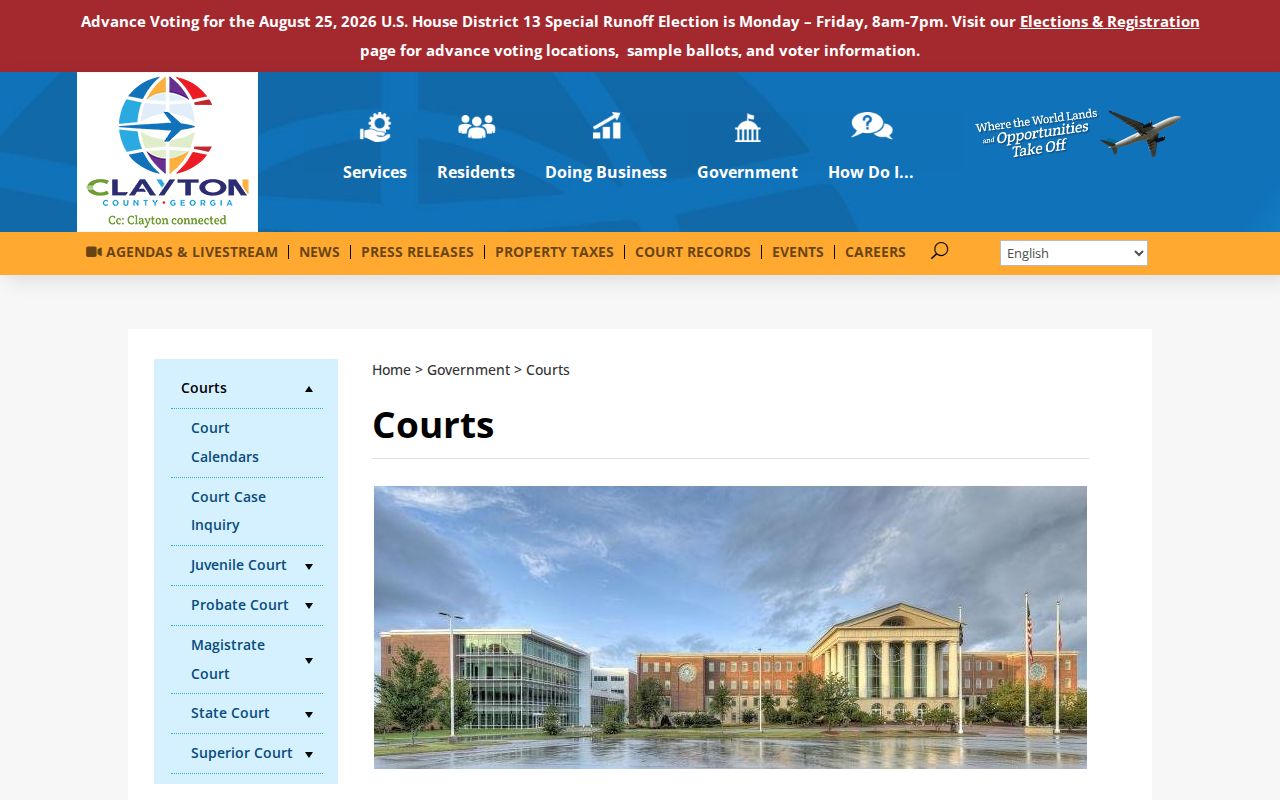
Treat that map as a routing aid, nothing more. One county search box never promises entries from every court's database.
How to Find Court Dates and Settings
A Clayton setting can surface in two places. Case Inquiry shows it as a Calendar row. The county also runs a separate Court Calendar CGI. Remember the difference between these tools. The docket is the historical register of a case's activity. The calendar only lists posted settings. A Calendar row can carry a date, time, room, judge, and calendar type, while the standalone calendar searches by name, date, case, or judge. If two rows clash, treat the newest un-cancelled event as a lead and confirm with the assigned clerk or court before relying on it.
Start with the case number in the matching division. Then compare the Calendar row against the broader date or judge result. The name calendar stops at the previous Monday, and the county warns that not all calendars are eligible for Internet posting. For a full field-by-field route, use the Clayton County Court Dates page. Got a city citation? Check it with that city's Municipal Court rather than assuming it sits in the county calendar.
When a setting matters, capture the details. Date, time, judge, calendar type, room: write them all down before you leave the result. A reset or event outcome can change things. So can a failure-to-appear row or an emergency closure notice.
Clayton County Calendar CGI
The calendar CGI is its own county application. Name searches take a last-name string. Dates use the month/day/year format. A case search needs the court division plus the case number, and a judge search takes a civil or criminal division. Results arrive in a table of Date, Time, Judge, Calendar Type, and View Calendar. One quirk: the view action may run through a verification token or Turnstile step, so a result row and the full calendar view do not always behave the same.
| Mode | Key input | What to watch |
|---|---|---|
| Name | Name text, maximum 70 characters | Search reaches the previous Monday and rejects blank or non-letter input |
| Date | Date in MM/DD/YYYY format | Results show date, time, judge, calendar type, and view control |
| Case | Court division plus case number | Six divisions cover State, Superior, and Magistrate civil and criminal calendars |
| Judge | Dynamic judge list plus Civil or Criminal | Names can include current and legacy or substitute entries |
This calendar route covers settings only. It does not replace the Case Summary or a certified filing. A blank result has many possible causes. It might be the date range, the division choice, a posting limit, an excluded calendar, or simply a reason to call the court. The web result can run thin. When it does, a public terminal or the clerk counter still does the work.
Public Access to Court Dockets
Georgia starts from openness. Still, public access to court records has limits. Uniform Superior Court Rule 21 governs access. Rules 21.1 through 21.5 lay out the motion and order process for restricting a file, and Rule 21.6 covers protected identifiers under O.C.G.A. 9-11-7.1. The Georgia Open Records Act, O.C.G.A. 50-18-70 through 50-18-72, controls many government-record requests. A court-file request still belongs with the clerk. Model Rule 36.16 gives e-filed documents the same force and public-access treatment as paper filings, subject to sealing and restriction rules.
Key rules:
Uniform Superior Court Rule 21 starts from public access unless a law or proper court procedure limits the record.
O.C.G.A. 50-18-70 through 50-18-72 set the Georgia open-records inspection, copying, exemption, and response framework.
O.C.G.A. 15-11-708 and 15-11-709 protect Juvenile information; JDEX is not a public substitute for a Juvenile docket.
Public access has a boundary. Copying everything is not the same as access. Protected identifiers, sealed filings, adoption material, protective orders, Juvenile matters, and some Probate material must follow the lawful route the custodian sets.
Clayton County Docket Access Limits
Clayton's search warning names the gaps plainly. Adoption, Juvenile, Probate, protective-order, sealed, pre-JIS, and out-of-county matters may not appear. So "no result" means "not available in this public inquiry," never "no case exists." A new entry may sit in the clerk's publication window still. Some entries take up to 72 hours to become visible.
Juvenile files live at the Youth Development and Justice Center. Confidentiality rules govern them. Probate estate records run through Georgia Probate Records and the Probate counter. City cases sit in city systems. A sealed Superior record answers to its restriction order. A restricted criminal-history record under O.C.G.A. 35-3-37 is a different product from a court docket. When an Image Document fails, ask the custodian. There is a lawful redacted, plain, or certified route. The missing image is not proof the event never happened.
The Juvenile Court explains its own specialized context. Clayton Juvenile Court's official page names the separate court and its location.
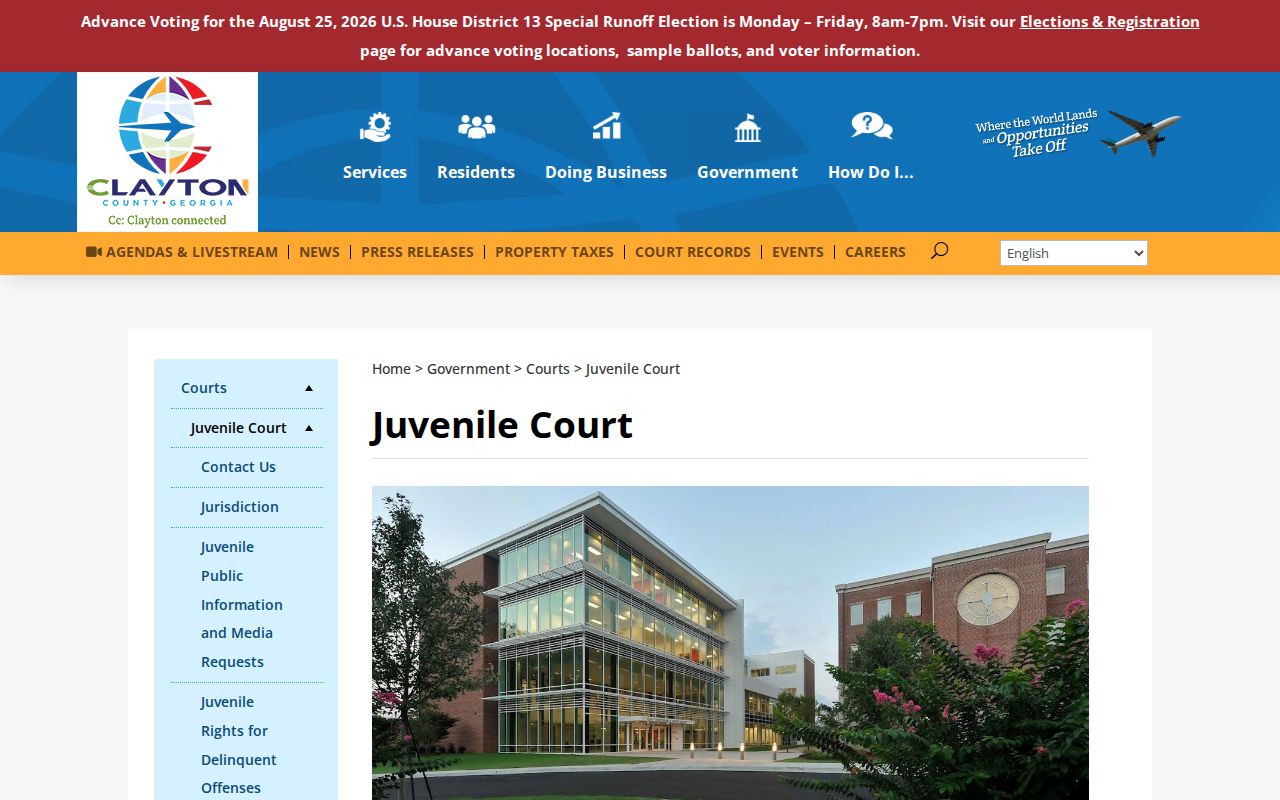
One county search box cannot speak for every court.
Docket Records at the Clerk's Office
Clayton County splits its clerk duties between two offices. Chanae Q. Clemons holds two titles. She serves as Clerk of Superior Court and Clerk of Magistrate Court. Her Superior Court Records Division handles civil, domestic, adoption, and felony records. Real estate runs through its own division. Tiki Brown is Clerk of State Court. She maintains State civil, criminal, traffic, and microfilm divisions. Probate keeps its own counter, and Juvenile keeps its own restricted files.
Superior and Magistrate Clerk
Harold R. Banke Justice Center, Rooms 1CL19 and 1CL25
9151 Tara Boulevard, Jonesboro, GA 30236
(770) 477-3405 Court Records; (770) 477-3395 Real Estate
Superior Clerk information is available through the official records office.
State Court Clerk
Room 1CL181, Harold R. Banke Justice Center
9151 Tara Boulevard, Jonesboro, GA 30236-4912
(678) 479-5521
State Clerk information is available through the official State Court records office.
Probate Court
Annex Building 3, 121 South McDonough Street
Jonesboro, GA 30236
Use the Probate counter for estates, wills, and guardianship files.
Start at the right counter. Half the trip is done. The Clayton County clerk's official pages walk through in-person requests, mail, online inquiry, and copy orders. What they skip is any full map of a dedicated public terminal. Georgia's e-filing standards expect free courthouse access or a paper fallback. The details live at each counter. Phone the office that holds the file. Do that before you count on a kiosk, a staff-assisted search, a cutoff time, or a delivery estimate.
The Superior Clerk's records office sits behind the county's public docket view. The Superior Clerk records source also covers eCertification and the Odyssey filing transition.
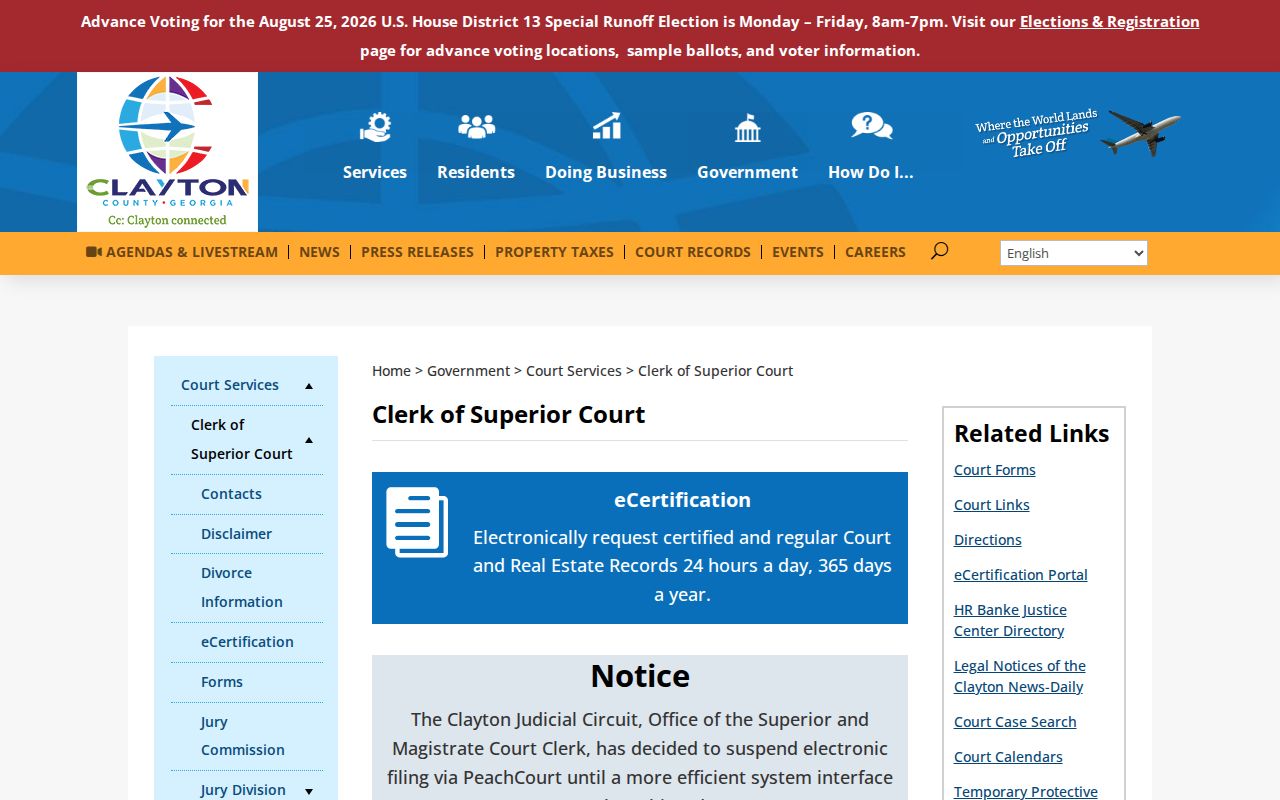
Finding a case online and ordering an official copy are two different errands.
Clayton County E-Filing Changeover
Clayton County civil and criminal e-filing now runs through Odyssey eFileGA. The switch took effect February 1, 2024. That followed PeachCourt's suspension. Filing, payment, service, and vendor-account tasks all moved with it. One caution applies. eFileGA is a filing route. It is not the free public Case Inquiry. To read a Clayton County court docket, start with the county search. To submit a document, a filer or attorney follows the clerk's eFileGA route instead.
| Channel | Main use | Access point |
|---|---|---|
| Clayton County Court Search | Free public case summary and Docket Activity | County name or case-number inquiry |
| Odyssey eFileGA | Electronic filing, service, and account-based submission | Tyler eFileGA account route |
| Georgia Courts E-Access | Directory of participating electronic-access providers | State provider directory, not one free statewide index |
Timing matters on the Magistrate side. The clerk warns that Magistrate civil docket entries can take up to 72 hours to show up. A payment or vendor receipt proves the filing went through, not that the public row is live yet. Hold on to the confirmation. After the stated window, check the case inquiry again, and call the office if the entry still has not appeared.
Probate runs its own estate search, a good example of a specialized route. It asks for county and deceased-name fields rather than the ordinary Case Inquiry. The official Probate Court information explains that separate counter and estate-record path.
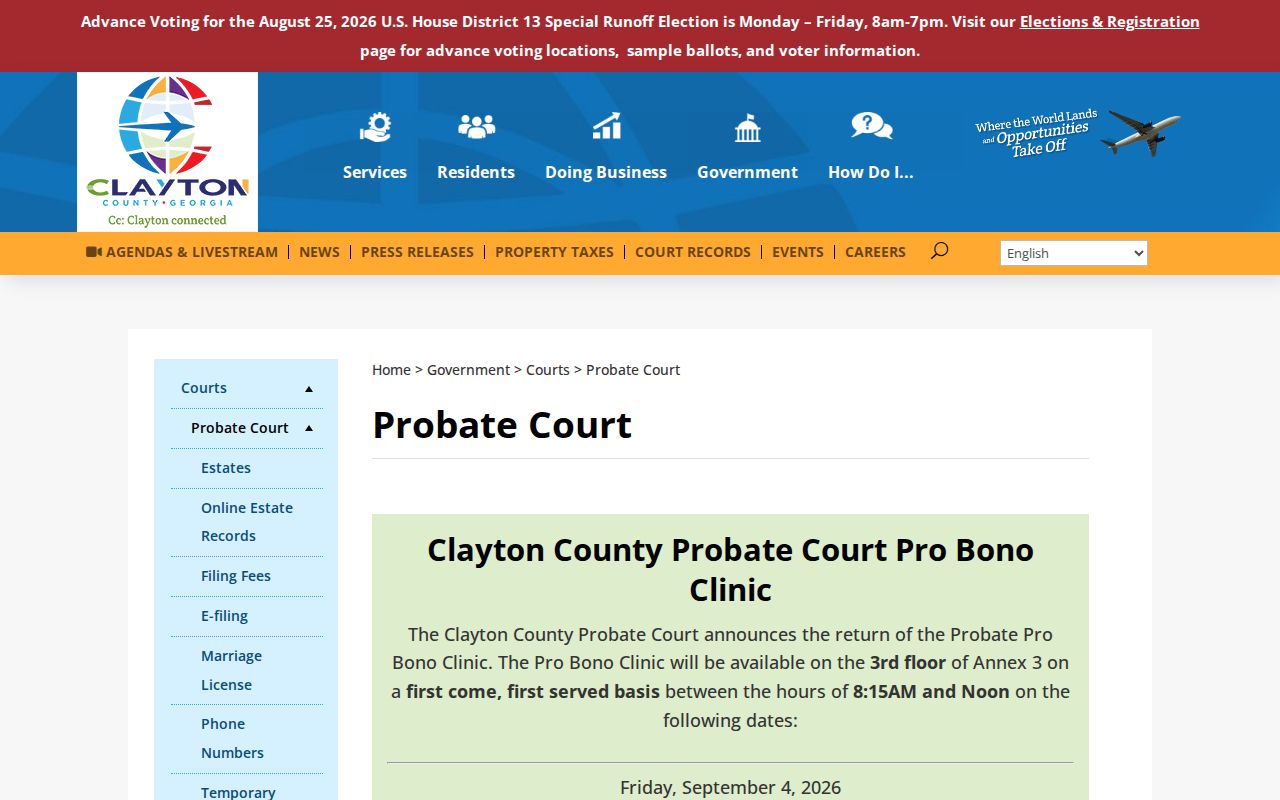
That separation is a feature, not a flaw. It keeps a probate search from looking like a failed Superior or State Court lookup.
Clayton County Clerk Access Paths
Different questions go to different offices. Tiki Brown's State Clerk route handles State Court traffic and misdemeanor matters. Clemons's Court Records Division takes Superior felony and broad civil questions. The combined Superior/Magistrate clerk structure covers Magistrate civil cases and warrants. ADA, interpreter, alternative-dispute, and specialty-court questions can go to the court administrator. That office is not the usual holder of the docket. Sending a request to the right clerk the first time saves a repeat trip.
For copies, name the case and say whether you need a plain, certified, or exemplified record. Ask the current amount and accepted payment method. Superior and Magistrate schedules accept cash, money order, and cashier's check. They also take a company check meeting the stated number rule, plus designated cards. Personal checks are refused under those schedules, and no refund is stated. State and Probate terms differ, so leave one division's fee rule at the door.
The official State Court information identifies the court's docket jurisdiction. That covers the county-wide misdemeanor, traffic, and non-exclusive civil side of the split.
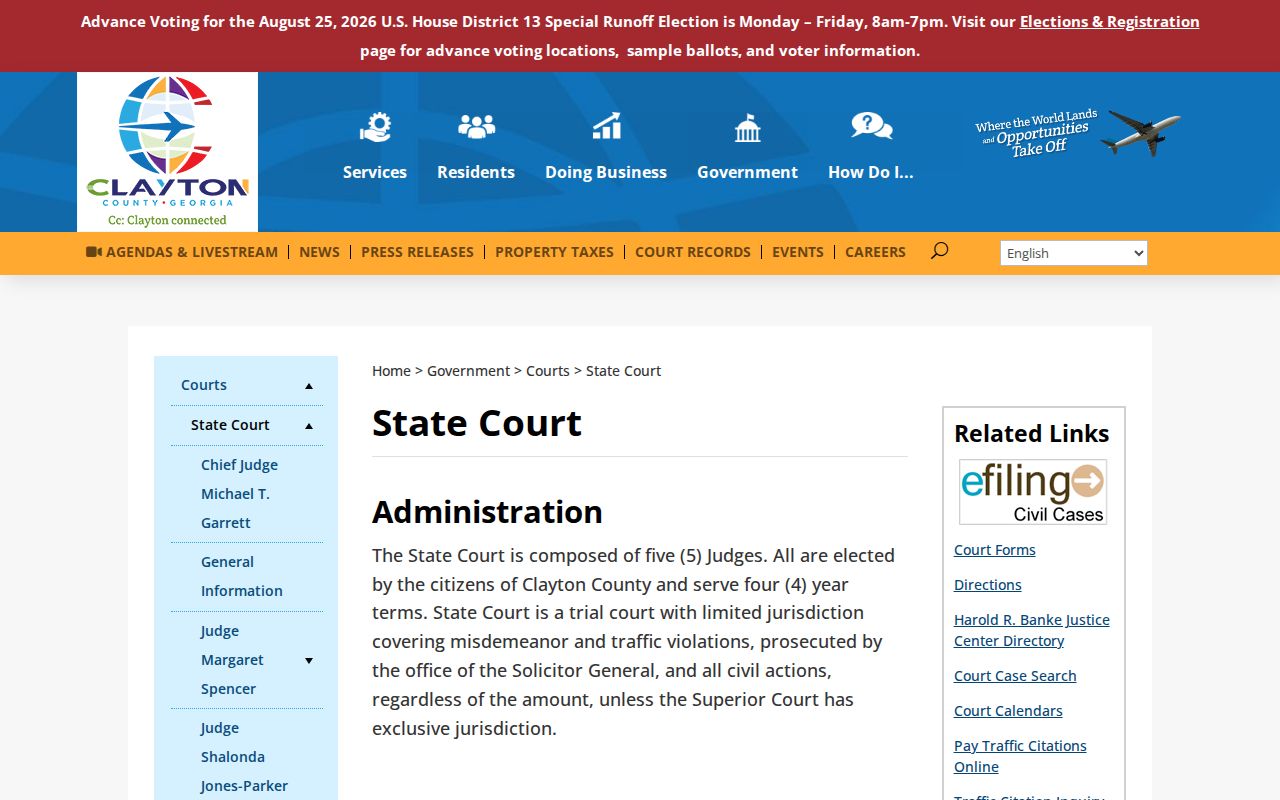
A quick routing check saves a second search. One office simply may not hold the Clayton County case you asked about.
Clayton County Court Record Terms
A docket has its own working vocabulary. "Calendar" usually means a dated setting row. "Action Date" is the date tied to an entry, which is not always the original filing date. "Final Case Disp" flags disposition activity, but it cannot replace the order or judgment itself. The county's criminal codes deserve their official definitions too.
- FOD
- First Offender Discharged, as defined in the county sentence and docketing abbreviation sheet.
- FOP
- First Offender Plea.
- NPS
- Nolle prosequi or nolle prosse terminology in the county code list.
- DIS
- Dismissed.
- DDJ
- Dead docket.
- GPN and GNN
- Negotiated and non-negotiated guilty-plea labels in the county definitions.
- NOL or NOLO
- Nolo contendere.
- DPS912
- A notice sent to the Georgia Department of Driver Services for failure to appear, not a driver-history record.
Copy a code along with its surrounding action and court. A shorthand disposition may point to the next document. That could be an order, sentence, image, or calendar outcome. Resist expanding it from memory when the county's official definition is on hand. The county's second Magistrate page pairs the court's public functions with the code list. That pairing shows why the two belong together. The Magistrate Court source is the official route for its hearing and civil functions.
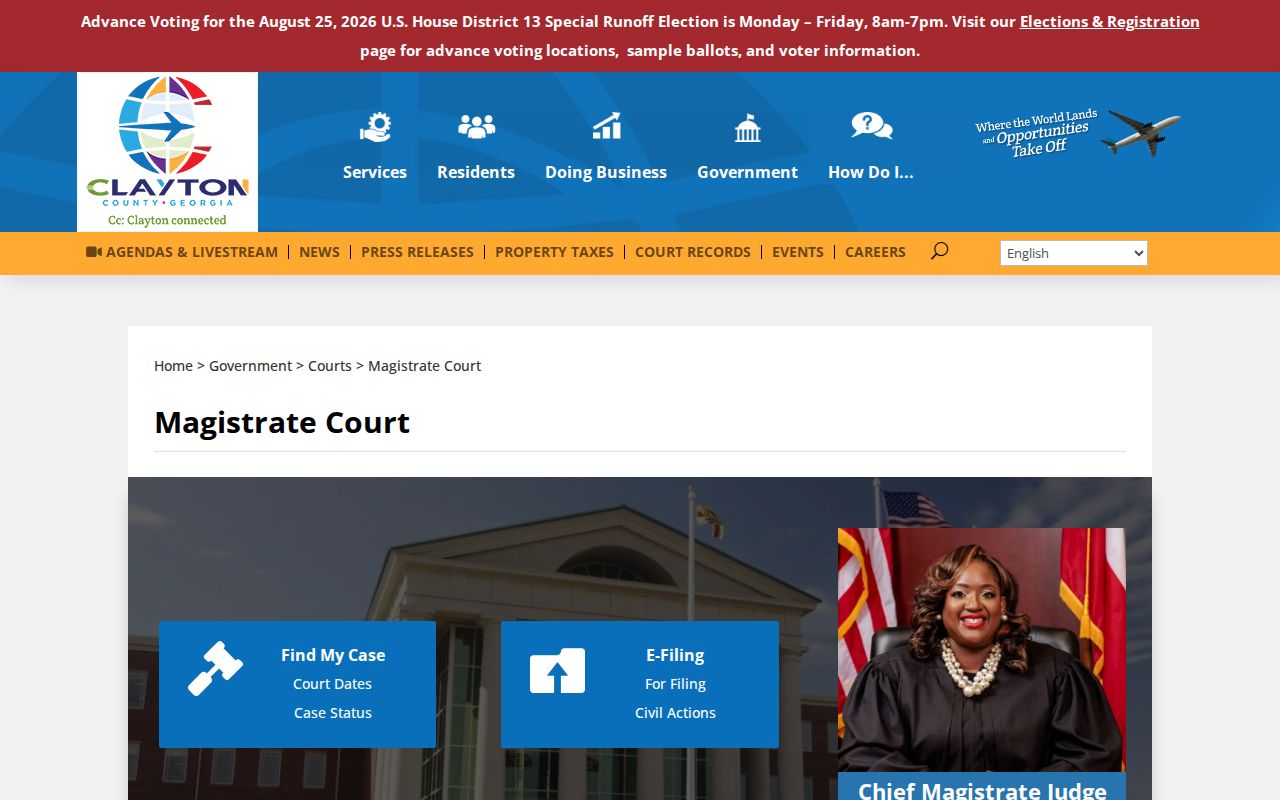
A clear court label keeps a Magistrate entry from reading as a Superior judgment.
Clayton County Clerk Copies and Fees
Online Case Inquiry finds a case; a clerk's copy fills a different need. Superior's schedule dated January 1, 2024 sets a regular copy at $0.50 per page in person without assistance. An assisted mail copy runs $1.00 per page. A certified or exemplified copy costs $2.50 for the first page. Each additional page adds $0.50. State Court's page dated July 1, 2024 lists a regular copy with the case number at $0.50 per page. Its certified copy is $2.50 for the first page plus $0.50 for each additional page, with distinct exemplified terms. Magistrate's 2023 schedule charges $50 for a civil action without service. Process-server service adds $65 per party.
| Record or action | Published amount and vintage |
|---|---|
| Superior regular copy | $0.50 per page in person without assistance; January 1, 2024 schedule |
| Superior certified copy | $2.50 first page, then $0.50 each additional; January 1, 2024 schedule |
| State regular copy with case number | $0.50 per page; July 1, 2024 fee page |
| State certified copy | $2.50 first page, then $0.50 additional; July 1, 2024 fee page |
| Probate plain copy | $1 per page; use Probate’s current instructions for other charges |
Those dates on the schedules are there for a reason: court fees change. Superior civil/domestic action fees and State Court filing fees are not the same figure, and a vendor may tack on a separate electronic-service or access charge. Ask which office controls the file. Confirm which schedule applies before sending payment.
Clayton County Records in Jonesboro
Jonesboro sits at the crossroads of court, clerk, and county history in Clayton County. The county itself dates to 1858. It was carved from pieces of Fayette and Henry counties and named for Judge Augustine Smith Clayton. Jonesboro started life as Leaksville in 1823 and grew up around the railroad. None of that changes a search field. It does explain why an online result often has to be routed back to a physical records office. That office sits in the county seat.
Some details belong to a phone call rather than a webpage. The county posts no official construction year, architect, floor count, parking inventory, or full terminal map for its buildings. Ask ahead about those. Ask the same way about delivery and identification rules for dynamic eCertification. For background that stands on its own, Clayton County’s official history page ties Jonesboro’s railroad past to the records center it is today.
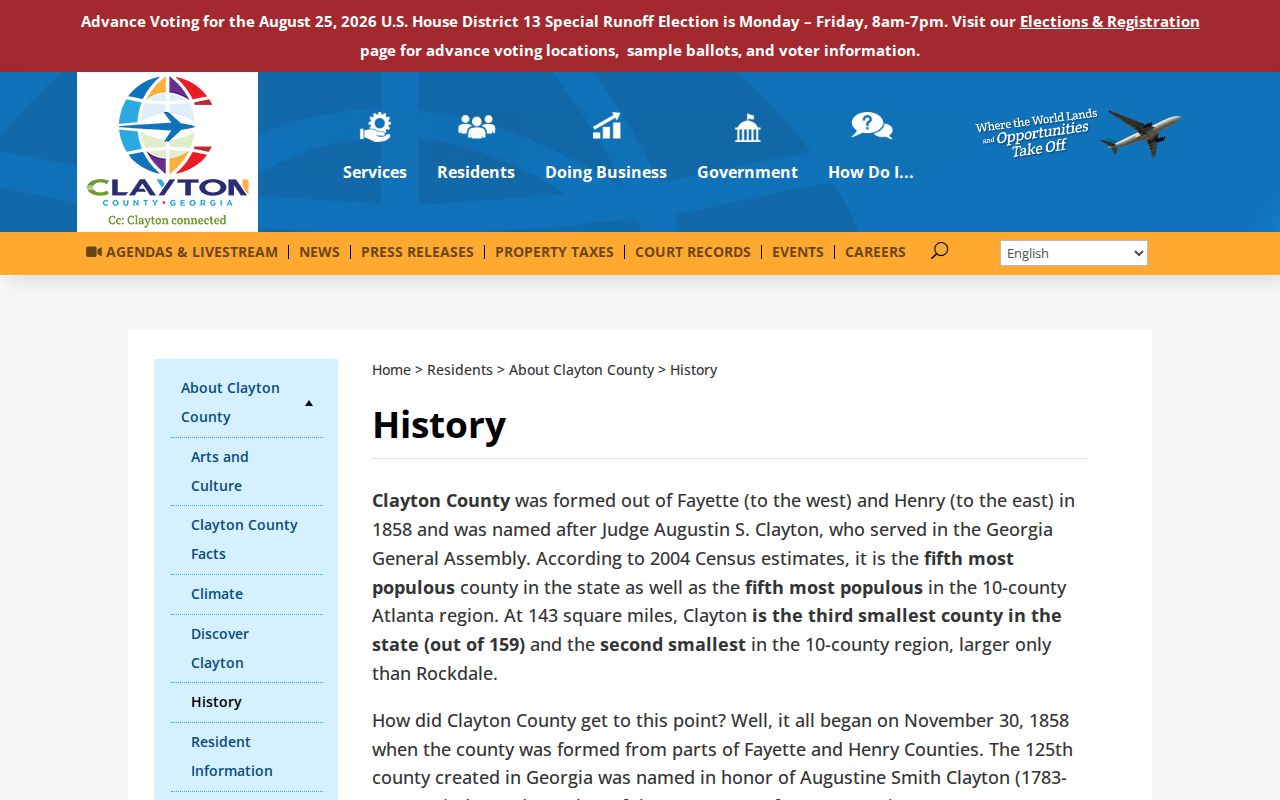
Local history earns its place here for one reason. It points every search back toward the clerk counters that hold the records behind the online docket.
Clayton County Court Dockets by City
Municipal courts handle the city-level traffic, ordinance, and selected misdemeanor dockets. By the 2020 Census POP100 table, the five largest incorporated places are Forest Park, Riverdale, Lovejoy, Morrow, and Jonesboro. A city ticket belongs with the city court’s own calendar or payment route first. If the city sends a transfer or an appeal up to Clayton State or Superior Court, follow that instruction, then run a county docket search under the correct court and case number.
Forest Park Docket Search
19,932 in the 2020 Census POP100; city traffic, ordinance, and municipal misdemeanor matters.
Riverdale Docket Search
15,129 in the 2020 Census POP100; Traffic and Environmental Court divisions.
Lovejoy Docket Search
10,122 in the 2020 Census POP100; municipal citation and code-enforcement routes.
Morrow Docket Search
6,569 in the 2020 Census POP100; traffic, DUI, marijuana, shoplifting, and ordinance matters.
Jonesboro Docket Search
4,235 in the 2020 Census POP100; city traffic, marijuana, shoplifting, and ordinance matters.
Those city rankings come from the official 2020 Census table, not current population estimates. City CourtWare and JusticeONE pages lean on ticket, violation, payment, and appearance fields that simply do not match the county CGI format. So a city record can be both real and public while never surfacing in the county Case Inquiry.
Clayton County Municipal Docket Routing
Each city court runs its docket a little differently. Forest Park holds Wednesday arraignments, with a separate phone route for payment and mandatory-appearance questions. Riverdale splits into Traffic and Environmental divisions and posts a CourtWare calendar. Lovejoy’s CourtWare calendar flags red tickets as appearance-required. It also puts a CE prefix on code-enforcement tickets. Morrow lists which cases demand an appearance but posts no public calendar field table. Jonesboro goes furthest. It offers CourtWare calendar and docket views. Appearance indicators and detailed disposition fields come with both.
Those differences matter the moment a county docket search comes back blank. Start with the city office, the court phone, or the city’s official vendor route. A city’s CourtWare docket number, ticket number, or citation number may not fit the county’s fields at all. The county system expects a year, type, sequence, and division. When a city says a matter is moving to State Court, write down the new county case number. Then search the matching State division.
Routing therefore runs in two directions. A county search can point down to the city office holding the paper. A city case can climb up to a county trial court. Either way, confirm details with the current clerk or court before acting on them.
Map and Directions to the Harold R. Banke Justice Center
Superior, State, and Magistrate Court files are all kept at the Harold R. Banke Justice Center, 9151 Tara Boulevard, in Jonesboro. Inside the building, the Superior Clerk's Court Records Division sits in Room 1CL19 and the Real Estate Division in Room 1CL25, while the State Court Clerk's office is in Room 1CL181. Probate is not in this building; its counter is at Annex Building 3, 121 South McDonough Street.
Harold R. Banke Justice Center
9151 Tara Boulevard
Jonesboro, GA 30236
(770) 477-3405 Court Records; (770) 477-3395 Real Estate
Front-door atrium hours 7:30 a.m. to 5:00 p.m., Monday through Friday, excluding county holidays.
Probate Court, Annex Building 3
121 South McDonough Street
Jonesboro, GA 30236
Monday through Friday, 8:00 a.m. to 4:30 p.m., excluding holidays.
The county does not publish the location or count of a public docket terminal, so call the relevant clerk before a visit that depends on one. State Court traffic payments close earlier, at 4:30 p.m., and Probate cuts off some applications at 3:00 p.m., so confirm the specific counter's hours rather than relying on the atrium hours alone.